

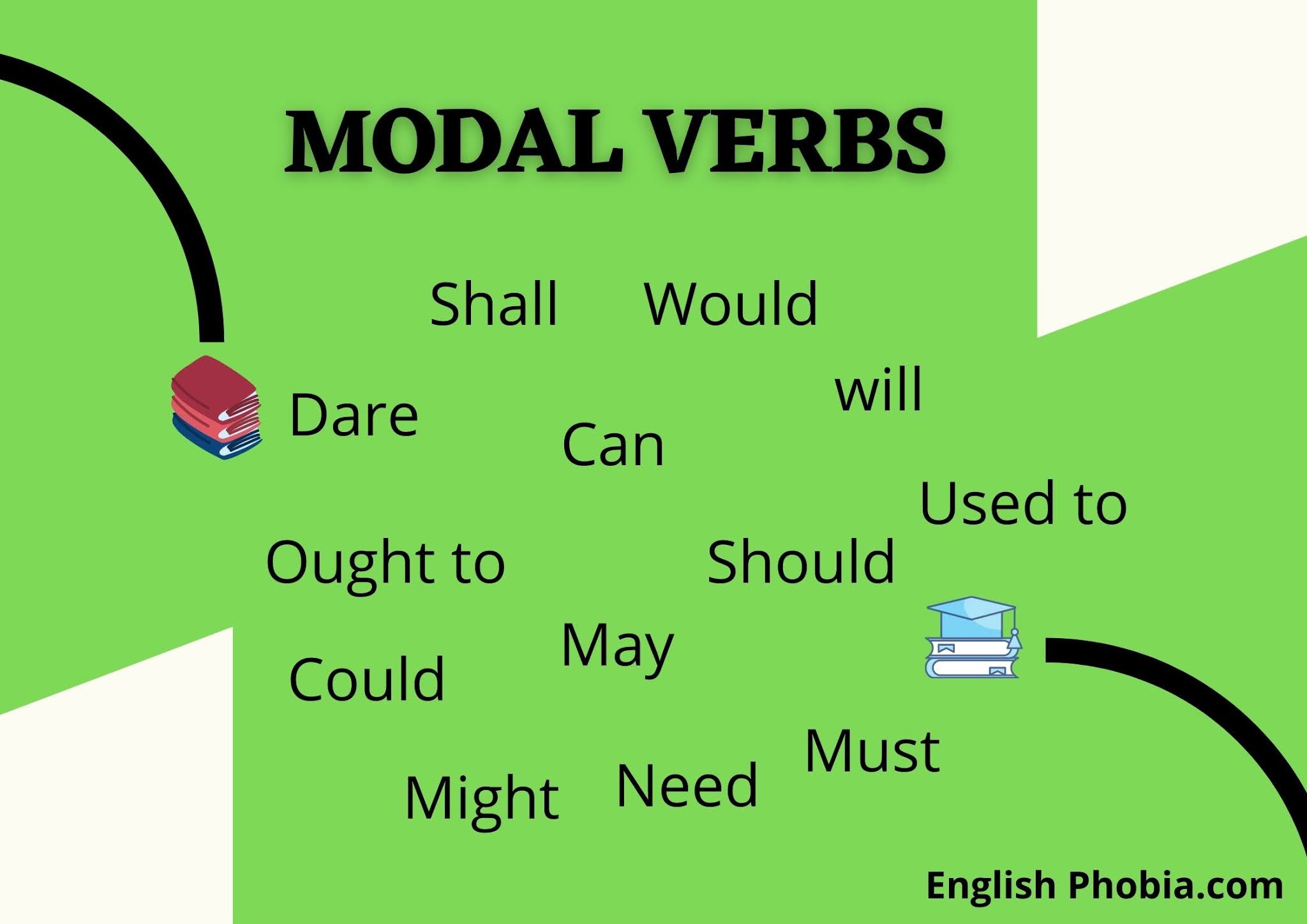
What is the definition of a modal verb?
A modal verb is an auxiliary verb that
helps to show suggestion, possibility, necessity, and permission more clearly in
a sentence through specific words like can, will, must, etc.
The modals chapter is a part of Finite Verb to understand it clearly I have attached a table for your help which shows finite verbs and their different types together.
|
Finite Verb |
|
|
Action Verbs |
Helping Verbs |
|
Transitive Verbs |
Primary auxiliaries |
|
Intransitive Verbs |
Modal auxiliaries |
|
Causative Verbs |
Semi Modal auxiliaries |
Here is a modal verbs list that displays all the modal auxiliary verbs that you are going to learn in this post today.
|
Modal Verbs List |
|||
|
Can |
Could |
||
|
Will |
Would |
||
|
Shall |
Should |
||
|
May |
Might |
||
|
Need |
Dare |
||
|
Must |
Ought to |
||
|
Used to |
|||
Learning a
language with native expression is very necessary to subdue it and catch the
native speakers correctly for better communication hence It is one of the
most important topics of English Grammar lessons which is “Modals”. It is very easy to learn and has perceivable usage too.
I have tried my best to give you lucid examples along with detailed information
for each modal verb and multiple usages with the formation and additional rules
together.
Can
Usage: It is used to show power, ability, informal permission, and
helplessness.
·
It is always used in the
present tense.
·
Takes the V1 form (basic form) of
the verb.
·
It is preferable to all the
singular and plural subjects equally.
· It takes ‘not’ with it when used in the negative expressions.
Cannot ✓ Can’t ✓ Can not ( X )
1. He can lift 100 KG weight with his left hand easily.
2. Romeo can score a rank in this exam off-hand (without
preparation).
3. She cannot go outside at night, come what may.
4. You can go wherever you want, but return before it is 8 PM.
5. Neha can’t cook delicious food for anyone.
Ø Can’t Help + V4 (V1 + Ing) used to show addiction or habit for something. It means it is
impossible to stay without this activity.
Note: This expression is always used in a negative and shows helplessness.
·
The children can’t help using
mobile phones today.
·
We can’t help earning in this
lavish period.
Will
Usage: it is used to describe future
possible actions.
·
It is always used in the future
tense.
·
Takes all the subjects.
·
In the negative expressions
either use ‘Will Not’ or ‘Won’t’ both are þ.
·
Used in the condition
sentences.
Examples
1.
He will complete this
construction project by February 2022.
2.
They will soon come to meet us
at Christmas.
3.
Sonu will not travel in general
coach in his life ever.
4.
If we are late, the teacher
will not let us enter the class without punishment.
5. If you learn modals, it will let you use them easily.
Should
Usage: It is used to give suggestions and keeps some effects of
questionable conditions.
·
It is always used in the
present tense.
·
Takes all the subjects
·
Always use V1 with it.
Examples
1.
We should obey our elders under
every condition.
2.
Rakesh should remind me of his
holidays to have an eye-to-eye with me.
3.
People should plant more and
more trees to reduce global warming and secure the future.
4.
If you have fever, you should
consult with a doctor immediately.
5. Should you go to the market (if you go to the market), please bring me a box of chocolate for my best friend.
Would
Usage: It has multiple usages to tell past
habits, wish, choice, preference, past assumption, formal asking, and past Will.
·
It is used in the past & the
present.
· Takes all the subjects equally.
Examples
Past Habits (in the past tense)
1.
Everybody would go to the circus in our
childhood with our parents and cousins.
2.
I would go for a morning walk
regularly before corona pandemic.
3. The students would go to school forcefully till 2020.
For Choice
1.
What would you like to have or
drink?
2.
How would you explain the new
education policy to the students and their parents?
3. I would rather learn a useful skill than waste my time scrolling the reels.
Past of Will
This use shows the future possibility of a past
action. Let’s learn with the help of the below examples.
1.
My best friends promise me that he
would be surprised to meet me on my birthday.
2. They all decided that they would meet after every 5 years in Iceland.
Preference
1.
I would like to choose this dress
for my marriage ceremony.
2. She would buy a red dress than a pink one.
1.
If he came, he would surely do the
leftover tasks on the same day.
2. Were I born with supernatural powers, I would fly in the sky.
It is a bit challenging task to gather a lesson of
multiple modal verbs at once if done, it becomes too long to be read or
understood easily thus for readers' convenience it is divided into two parts.
This is the first part where you have only four modal verbs Can, Will, Should, and Would rest all the model verbs will be in the second part will example
and multiple usages.


1 Comments
Nice 👍
ReplyDelete