

This
article is all about how you can use the advanced verbs in your communication
skill wherein you will learn about what the additional verbs are and their
multiple uses.
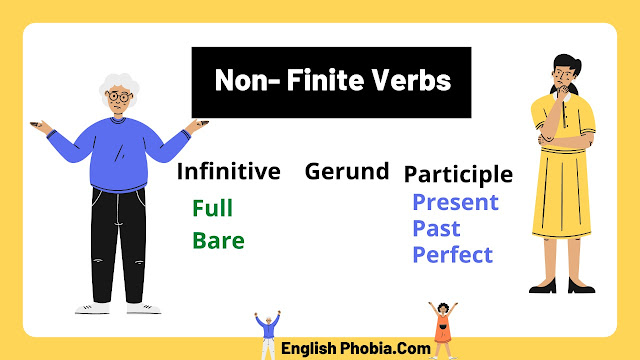
There are two types of verbs first is Finite verbs which we have already discussed in our previous post and the second is Non- finite, a part of verbs and also known as advanced verbs because these are quite different from the normal verbs. People don’t know how to use them easily hence this becomes quintessential for everybody to learn. Here is an easy explanation for all the types of non-finite verbs.
Non-Finite
Verbs
1. Infinitive
2. Participle
3. Gerund
There
are three types of Non-finite verbs in English language. But each has its own
separate types and uses. We are going to learn the same with this article how
to use them correctly.
|
Non
- Finite |
||
|
Infinitive |
Gerund |
Participle |
|
Bare |
Present |
|
|
Full |
Past |
|
|
Perfect |
Let’s
start with learning Infinitive first .
There
are two types of infinitive
1. Bare
means (without To V1)
2. Full
means (with To V1)
Now
it is time to learn all the uses of infinitive in detail.
How to Use an Infinitive
1. Purpose
2. In
passive voice
3. Perfect
infinitive
4. Perfect
passive
5. Continuous
infinitive
6. Perfect
continuous
7. A
subject
You
can use an infinitive in the above multiple forms.
There
are certain rules that you must keep in mind to use the infinitive with
multiple forms in English.
Rule no. 1
A (Verb/Adjective/Noun) +
Infinitive
Verbs
While
using the infinitive in a sentence when it comes after an action in the
sentence as a secondary verb just as shown in the below examples.
1. The
students come to learn English here. (active
voice)
2. They
wish to be taught efficiently. (passive voice)
3. He
works to be success. (no verb)
4. To
speak English fluently, you must practice it.
(as a subject)
Adjectives
There
are some adjectives and verbs which are followed by infinitives.
Need,
desire, agree, hope, wish, fail, glad, easy, eager, curious, ready, accept,
sorry, want etc.
First
I have shown you the sentences with adjectives and later with the verbs.
Sentences with adjectives
1. I
am glad to wish you Happy Diwali in advance.
2. They
were always ready to learn new things.
3. I
will be ready to bear the consequences.
4. She
was sorry to have missed the class that day.
5. It
was easy to restart my life.
Sentences with verbs
1. I
wish to get a job as a content writer.
2. They
have failed to fulfil the basic needs of life.
3. She
accepted to have made a mistake in the project.
4. We
hoped to stay calm in this regard.
5. They want to clear the U.P.S.E examination at once.
W.H.F+ Infinitive
When
a speaker intends to describe the way, time, place, any person, etc. he uses
infinitive with W.H.F words. In case you don’t know about W.H.F. words, I have
mentioned them below for your assistance.
What,
when, why, who, whose, whom, which, where, how etc. are the words of a family
make a W.H.F.
Let’s
look at some examples now.
1. He
knows how to drive a car.
2. They
are learning how to speak in English.
3. I
don’t know what to do now.
4. They
don’t have any idea when to apply for resignation.
5. She
guided me whom to talk about my problem.
6. They
explained me why to choose mutual funds for investment.
7. I learnt how to write an article using keywords.
Rule no. 2 Difference
between ‘To’ and ‘For’
I am giving you examples for a little identification and differentiation between ‘To’ and ‘For’ if you can’t get it yourself, you need not worry because the explanation is given below for them.
1. I
come to learn English here. (Correct for a purpose)
2. I
come for learning English here. (Incorrect)
In
the first sentence to + V1 is the correct use of a verb as an infinitive
because it shows here a purpose of an action according to the verb not
according to the subject. For your distinctive understanding I am sharing the
facts where you can use (For + V1+ Ing). After going through these facts you
will easily use both of them.
For
+ Present Participle (V1+ ING) also known as V4
We
use For + V4 when the purpose is according to the subject to the verb. Look at
the examples below for it.
1. This
book is to read. (incorrect)
2. This
book is for reading. (correct)
In
the first sentence the subject book belongs to the verb read hence it should be
reading just as it is mentioned in the second sentence because the action of
the sentence depends on the subject. There are some other examples also for the
same concept which you will help you out to understand it better.
1. This
is keyboard is for typing in Hindi and English both.
2. MI
phones are for calling, clicking photos and challenging the speed in
comparison with other brands.
3. This
machine is for fabricating the steel sheets.
4. The
pen is for writing not for reading.
5. This
article for learning verb
definition and examples.
6. The
teacher is available in schools for teaching.
Just
as in the above examples the task is related to the subjects hence I have used
FOR + V1 + ING according to a grammatical rule for the formation of such an
arduous concept.


0 Comments